
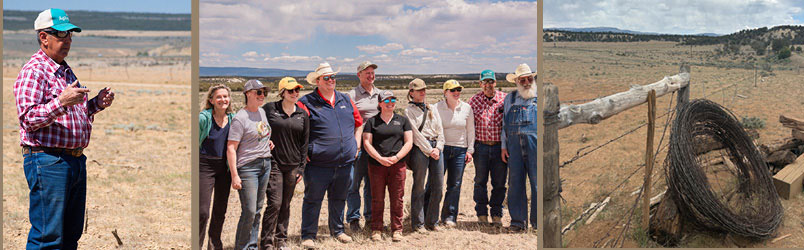
A Day on the Hibner Ranch
July 1, 2026
In May, Charles and Verna Hibner welcomed more than 60 government officials, community members, and conservation enthusiasts to their ranch to discuss how soil health and land management are essential to a range-based operation. A long-time practitioner of soil health, Charles Hibner has applied the knowledge and skills gained during his career in natural resource conservation to his own ranch, watching his soil health steadily improve over the years.
To start the day, the Rocky Mountain Farmers Union (RMFU) sponsored coffee for the group. Hibner provided a warm welcome, followed by brief remarks from Emily Paul (Director of Federal Government Relations at RMFU), Xochitl Torres Small (Executive Director of the Quivira Coalition), Anna Stearns (from the Forest Stewards Guild), and representatives from local Conservation Districts.
As the discussion turned to the core principles of soil health, Hibner emphasized that our relationship with the land is deeply rooted in geological history. Beginning more than 5 million years ago, he traced the evolution of the landscape down to the present day.
To support these ongoing efforts, the Hibners have leveraged funding from federal programs, including the Environmental Quality Incentives Program (EQIP) and the Conservation Stewardship Program (CSP), to improve land resilience and reduce soil erosion.
During the tour, Hibner shared that through strategic disking, mowing, and seeding, he has been able to increase the amount of available forage on his ranch tenfold while preventing invasive or unwanted plant species from overtaking his grazing lands. By prioritizing these practices, he has been able to incorporate organic carbon and organic matter into the soil horizons, significantly increasing the soil’s water-holding capacity. In the water-scarce environments of the West, this is critical to ensuring that when rain does fall, the ground cover is optimized to make the absolute most of every drop.
In addition to vegetation management, Hibner has installed several conservation structures across his property to address specific resource concerns. He explained to the group that deep arroyos had previously formed on the land, prompting him to combat severe water erosion by building dams. These structures now serve a dual purpose: providing reliable water sources for livestock and wildlife while actively mitigating further soil erosion.
Additionally, Hibner has established a highly innovative rotational grazing system across both his private lands and his Bureau of Land Management (BLM) and Forest Service (FS) grazing allotments. This adaptive management approach provides the flexibility for complete rest in some years and strictly limited grazing windows in others.
Beyond grazing, he has executed several tree-thinning and “lop-and-scatter” contracts. These efforts have significantly boosted the grass understory while cultivating a much healthier, more resilient forest ecosystem.
To share his knowledge with the wider community, Hibner has hosted four ranch field reviews. These events allow him to teach others the vital importance of soil conservation and demonstrate firsthand how dramatically these practices can improve land health and productivity.
Photo credits:
Left: Charles Hibner in Chama, NM, Photo: Cathy Day
Middle: Rocky Mountain Farmers Union Members in Chama, NM, Photo: Cathy Day
Right: Hibner Ranch, Chama, NM, Photo: Ivy Jean Reynolds