
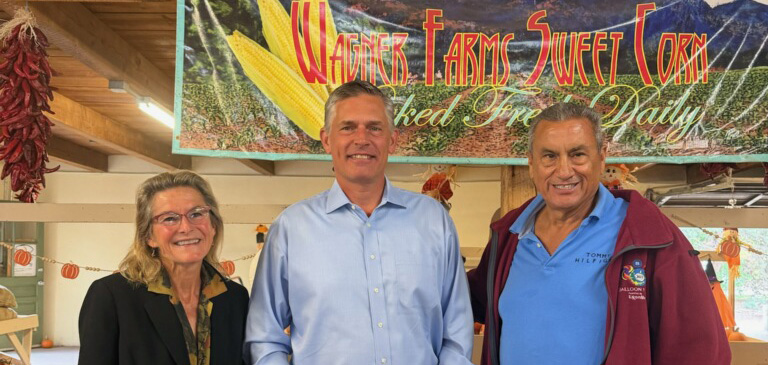
New Mexico Food System Leaders Meet with Senator Heinrich
November 28, 2026
Article by Ivy Jean Reynolds
On October 13, 2026, New Mexico farmers, ranchers, and local food system leaders met with U.S. Senator Martin Heinrich at Wagner Farms in Corrales, NM. The roundtable focused on high fuel prices and the economic factors hurting farmers and ranchers in New Mexico that sell directly into the local food supply.
Participants included Pam Roy, New Mexico Farm to Table; Anthony Wagner, Wagner Farms; Alan Brauer, Indigenous Farm Hub; Elan Silverblatt Buser, SilverLeaf Farms; Gilbert Luis, Acoma Number 8 Ranch; Helga Garza, Agri-Cultura Network; Johannes Lencer, Frontier Food Hub; Manny Encinas, Trilogy Beef and Buffalo Creek Ranch; and Zach Ben, Bidii Baby Foods.
For Johannes Lencer, interim CEO of the National Center for Frontier Communities (NCFC), the conversation was critical to highlighting the financial pressure on New Mexico’s local food infrastructure and how that infrastructure connects farmers and markets.
Frontier Food Hub, a program of NCFC, is a food marketing and distribution service that connects farmers and ranchers with institutional buyers, including schools and food pantries. Because New Mexico is so rural, this means that Frontier Food Hub travels huge distances to bridge the gap from the farm gate to the dinner plate. Lencer noted that their vehicles travel approximately 2,000 miles each week, making fuel prices a major factor in their operating budget. According to Lencer, the organization’s fuel expenses increased by more than 50% by the end of September, putting additional pressure on an already strained budget.
Alongside rising operating costs, changes to federal funding programs have created additional challenges for organizations supporting local food systems. Frontier Food Hub previously participated as a vendor in the USDA’s Local Food Purchase Assistance (LFPA) program, purchasing food from local producers and distributing it to food banks and pantries. The program provided an important market for farmers and ranchers while increasing access to locally produced food in communities across New Mexico.
New Mexico lawmakers approved funding for a state-supported continuation of local food purchasing during the 2026 legislative session. However, Lencer noted that the roughly year-long gap between federal and state support created significant challenges for the organizations and communities relying on the program. While New Mexico has taken steps to preserve these local purchasing relationships through state investment, the loss of federal funding has left similar programs in other states facing an uncertain future.
Senator Heinrich has been fighting to reinstate LFPA and Local Food for Schools (LFS) and even argued that if Congress were to consider an ad hoc program to provide relief for farmers and livestock producers need to be included in the program’s funding structure.
While reinstatement of LFPA and LFS hasn’t been successful in Congress yet, Senator Heinrich has been able to secure additional funding, in his capacity as an agricultural appropriator, for the Local Agriculture Market Program (LAMP). LAMP supports the development and expansion of direct farmer-to-consumer marketing; local and regional food markets and enterprises, and value-added agricultural products. Senator Heinrich continues to champion programs that invest in the local food system.
Building robust local and regional food systems is critical to ensuring a safe and abundant food supply. Keeping more food production, processing, and distribution within the region helps circulate dollars through local businesses and supports rural economies.
Shifting the food economy to a system that prioritizes local and regional foods will take a large public investment. A local food supply is not born just out of incentives to plant or an incentive to purchase local products. The entire supply chain will need to have support to be successful and bring prosperity to rural communities.
Organizations like NCFC highlight how important it is to have the middle of the supply chain focused and dedicated to a local and regional food supply, but without meaningful public investment, these organizations face steep financial hurdles in order to remain viable.
See also KUNM’s coverage of this story.
Photo: Left to Right: Pam Roy,, Policy Director; US Senator Martin Heinrich; Anthony Wager, Owner, Wagner Farms